



Matthew Evans at work on The Gardens at Hill Top Farm, Cumbria
Follow this guide to acrylics by Matthew Evans to learn colour-mixing ideas, practise acrylic painting techniques.
Why choose acrylics as a medium?
Acrylic can be used as a transparent glaze with the addition of a gloss or matt flow improver, as a semi-opaque medium, or fully opaque when applied straight from the tube. The faster drying times allow you to create an impasto (textured) effect similar to oils, but without the use of solvents, as acrylics mix and clean up with the addition of water.
They’re also non-toxic and safe for children to use. You can now buy water-based oils, but they still take longer than acrylic to dry. You can also build a wide collection of painting tools, including brushes, palette knives, rollers and even sponges.
Acrylic colours

My favourite colour palette has developed over the years, although I have several favourite themes including florals, woodlands and sunsets so the range of bright colours in the acrylic range are really useful.
- Cerulean blue is great for skies
- Cadmium yellow deep and cadmium yellow hue, Naples yellow, crimson, cadmium red and deep violet are all good choices for flowers
- Cerulean blue and cadmium yellow deep (or in hue form) make a great green, which can be darkened with crimson
- Cobalt blue is good for bluebells
- Phthalo blue and Prussian blue with deep violet are good for vibrant darks and to give contrast to the floral highlights
- Earth colours include burnt umber, raw sienna and yellow ochre, which I use for the background soil in garden scenes
I also keep a couple of colours that cannot be mixed easily, including magenta for bright pink flowers and cadmium orange (a beautifully vibrant colour) makes a good brown when mixed with phthalo blue and crimson.
I prefer to mix my own greens, but I’ve used a couple of premixed greens, including sap green and light green. My palette is complete with titanium white.
Your palette will grow gradually, depending on your personal preference and your choice of subject. You can, of course, buy introductory sets with a pre-chosen range of colours, but be prepared to own a few colours that you’ll never use, such as black.

Surfaces for acrylic paint
I’m constantly experimenting with new surfaces, but I particularly like to use pre-primed stretched canvases, either standard or deep edge. These canvases are popular with art buyers, as they have a contemporary feel, and with painters as they don’t need to be framed or put under glass. This is especially useful if you want to rework the painting in the future, as you don’t need to dismantle expensive frames.
Examples of acrylic paintings on different surfaces

Blossom Trees, acrylic paint on plywood, 17x27in (43x68.5cm)
This is a work on plywood, which, when primed with two coats of gesso, makes an excellent and firm support for acrylic. It also has a beautifully smooth surface, which suits detailed work. Here I enjoyed building up the layers of colour on the leaves and blossoms in patches of pure colour, contrasting with the bright blue sky. The colours are also reflected in the greens of the grass and I like the way the path leads the viewer through the picture.

Wellholme Park Flowers, acrylic paint on stretched canvas, 16x20in (40.5x51cm)
The canvas was covered with a roller and acrylic paint to give a fast and lively start. Texture paste was then applied both on its own and mixed with colour. When dry this gave a great surface to build up layers of trees and flowers. The bright floral colours were ideal for the foreground.

The Gardens at Hill Top Farm, Cumbria, acrylic paint on canvas, 20x30in (50.5x76cm)
I used a roller to apply the underpainting to this large canvas, which gave a particularly interesting effect to the sky. Building up a dark background helped to achieve contrast as the brighter floral areas were added. I can get lost in a subject such as this, as I dab away using ever-decreasing brush sizes to add as much or as few details as I wish.

Bluebell Wood, acrylic paint on paper, 6x7in (16x17cm)
As a small work on paper this could be an ideal study for a larger painting for working out composition and colours. Although this was completed inside, you could quite easily work in the field on small sheets of paper or canvases. You can even buy pads of acrylic primed paper, which are ideal for outdoor work. As acrylic paint dries quickly, you don’t have to worry about transporting wet paintings home.
If you're new to acrylics, don't stop here! Explore our other beginner-friendly guides to learn all you need to progress and develop your acrylic skills.
Acrylic painting techniques
Try these acrylic techniques to help you get started with acrylic painting.
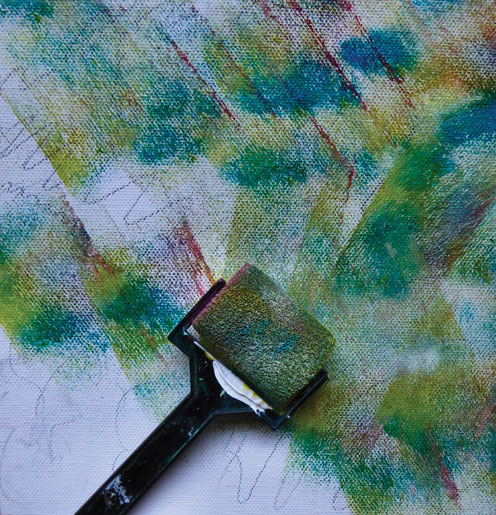
1. A foam roller can be used for special effects and to cover large areas quickly.
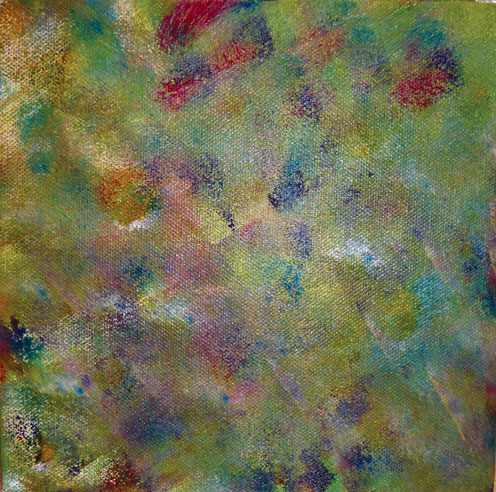
2. A really interesting coloured background that’s ideal for florals can be built up by layering pure colour over the top.

3. Mixing colours with a roller on the palette creates an interesting effect in itself.

4. A roller is an ideal way of working acrylic colour to pick up the texture of a handmade surface. Here I used paint straight from the tube in a similar way to inking up a printing block.

5. A stipple effect with a small brush is ideal to build up multiple flowers when you use paint straight from the tube or with texture paste.

6. A textured underpainting works well as a base for more details to be added on top. Texture paste dries solid and won't be disturbed by painting over it. This is the base for Wellholme Park Flowers.

7. Acrylic is also good to use on natural paper that has been manufactured with flowers and leaves in it. Such paper adds to a floral composition.

Matthew David Evans, based in Brighouse, West Yorkshire, finds inspiration in subjects rich in colour, light and texture. Favourite themes include atmospheric sunsets to bright floral scenes. Visit Matthew's website here.
Now you've learnt some acrylic painting techniques, try this article by Jackie Garner to learn how to use blocking in techniques to paint a landscape or visit our ultimate guide to acrylics for more advice and demonstrations on getting started with acrylic painting.
Comments
Login or register to add a comment