


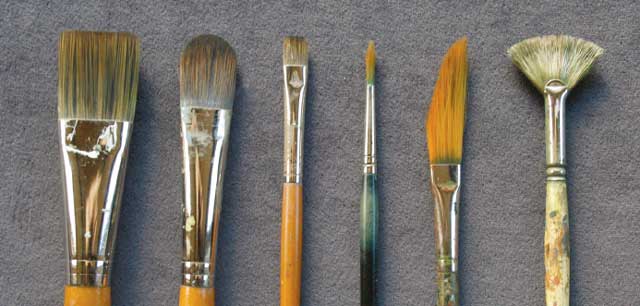
Follow Jackie Garner’s easy guide to the best brushes for acrylic painting, and learn how to choose and care for acrylic paint brushes.
Although alternative tools are available, we mostly use brushes to apply acrylics. These are the main types of paint brushes to consider for acrylic painting -
Round

So named because this brush looks round when viewed end-on. The bristles taper to a point, allowing the artist to produce strokes of varying widths. Sizes vary from Nos. 00000 (or 5/0) to about No. 20. The larger the number, the larger the brush.
Rigger

Like a round, but with much longer bristles, the rigger is used for making long, thin lines.
Filbert

Imagine your round brush has been flattened at the end. The longest bristles are in the centre and the shortest at the sides so the tip becomes a rounded shape. The more pointed shape is sometimes called a cat’s tongue brush.
If you're new to acrylics, don't stop here! Explore our other beginner-friendly guides to learn all you need to progress and develop your acrylic skills.
Flat

Like a filbert, the flat’s bristles are all the same length. It is also called a One Stroke brush. Both filberts and flats can be numbered 0, 1, 2, 3 and so on, or in fractions of an inch. The latter refers to the width of the bristles, not the length.
Sword liner, dagger or angled

Like a flat, but the bristles are arranged at an angle, shortest on one side, longest on the other.
Fan

As the name suggests, the bristles are arranged in a fan shape. It is also known as a blending brush, referring to its original purpose. I recommend hog’s hair for this brush.

Natural vs synthetic paint brushes
For acrylic painting, synthetic brushes are usually best, as their robustness stands up better to the rigours of acrylics - save your beautiful sables for watercolour. Any of these brushes are available as natural (animal) hair or synthetic.
Now you know which paint brush to use for acrylic painting, put your brush to paper with our collection of acrylic painting guides.
Acrylic brush sizes

Acrylic brushes have either a long (12in) or short (6in) handle. Your choice comes down to personal preference, although I find shorter handled brushes more suited to small paintings.
These brushes are both No 8, but the bristles are different lengths. Shorter bristles give more control, while longer bristles enable expressive brush marks.
Top tip: if in doubt, buy larger brushes. They will be more useful than tiny ones.
How to care for acrylic brushes

If your brush came with a plastic tube over the bristles, discard that, as it’s only to protect the brush until the first use. Never try to put it back over the bristles; it'll stop the brush from drying evenly and likely cause some bristles to splay out, spoiling the brush.
As acrylic paint dries quickly, it’s vital to clean your brushes, or other tools, promptly. Wipe any excess paint off the brush onto a newspaper or rag. Wash the brush until the water runs clear, ensuring there's no paint at the base of the bristles then wipe the brush on a piece of kitchen roll to remove excess moisture, reshape if necessary, and leave to dry.
Store the brushes in a brush case if you don’t plan to use them for several days. It's important to not leave your brushes standing on their bristles in water. There are two reasons for this:
- Moisture seeps into the wooden handle. This expands and cracks the varnish, which may flake off and loosen the ferrule (the metal part of the brush).
- The point will become misshapen and unusable.
Top tip: a bamboo brush case protects your brushes and allows the air to circulate so damp brushes dry naturally.


Jackie Garner is a Gloucestershire-based wildlife artist. View her work by visiting www.jackiegarner.co.uk or read Jackie’s blog at garnerwildlifeart.wordpress.com
Comments
Login or register to add a comment
No comments