


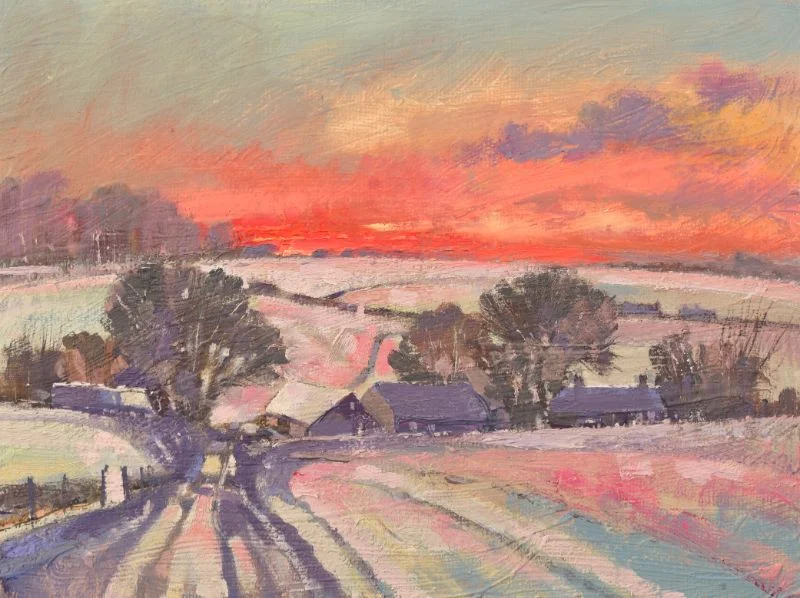
The Lane through to Cotes Heath, oil on board, (30x40cm)
Learn how to select the right colours to paint this winter sunset, in oils, with Alan Bickley.
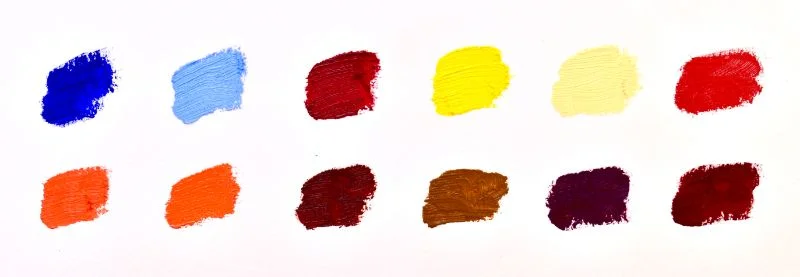
Top row: ultramarine blue, King’s blue, permanent rose, cadmium yellow, Naples yellow, cadmium red. Bottom row: cadmium orange, vermilion, burnt sienna, raw sienna, manganese violet, alizarin crimson
"There are so many options, but in general I tend to go for warm saturated colours, like reds, oranges, yellows, magenta and purple, and the combinations achievable from these colours are endless," says Alan, "You can potentially mix hundreds of combinations from this limited selection."

Making sketches
It can be a useful exercise to quickly sketch out a few sunsets to test out various colour combinations.
The below are oils on oil canvas paper, each 8 x 10cm.

Step 1

I’m painting on a smaller size board than usual for this local landscape, trying out a Jackson’s Rough Jute Linen board.
I started off by applying a couple of coats of acrylic gesso, thickened up with white chalk dust (A S Handover), randomly brushing this on the surface with a 1-inch household paint brush, making sure to leave visible brush marks in all directions.
This makes for a lovely surface to paint on. Edward Seago used a similar prepared ground, using rabbit-skin glue and white lead, but we can’t go down that route!
Once this had dried I applied a thin transparent wash of burnt sienna over the surface.
With a mix of raw sienna and some ultramarine I then drew in the basic structure of the buildings and trees etc, on this occasion positioning the horizon fairly high up the composition.
Top tip: It’s always a bonus if you have the perfect ‘lead in’ to the scene, and the lane running through the buildings was perfect, leading the eye nicely up to the focal point of the winter sunset.
Step 2

Now for the exciting part, getting the main framework blocked in and introducing some of those gorgeous warm colours into the sky.
I’m not going to laboriously name each colour as I progress because that can be so difficult to follow, and I’ve already suggested a useful colour palette earlier on. You’ll find it much more satisfying to use my stages as a general guide and just do your own thing and at your own pace.
The colour of snow will always be determined by the light, surrounding buildings, trees and so on, and almost certainly the colour of the sky will have a major influence.
I’ve varied the colours throughout, introducing muted blue/greys for some of the shadows and dragged some of the reflected red from the sky into the foreground.
Top tip: I work fairly quickly, so on a small size like this I would probably complete this stage in say 20 minutes or so. I never want my paintings to look laboured and static.
Step 3

Now to block in the buildings and trees, and generally rework the snow-covered fields.
I’ve deliberately painted the fields darker so that I can work over them with some lighter tones and add some highlights in the final stage.
For the roofs in shadow I used a mix of ultramarine with a hint of alizarin crimson, continuing a darker version of this colour into the lane.
The distant mass of woodland and the middle distant trees were loosely scrubbed in by adding burnt umber to the already mixed colours on my palette.
If you're new to oils, don't stop here! Explore our other beginner-friendly guides to learn all you need to progress and develop your oil skills.
Step 4
There isn’t a lot left to do on this now, generally reworking the buildings. The upper part of the sky was beefed up a touch and some minor adjustments to the sunset itself, adding a touch more intense orange towards the horizon.
A few dabs of slightly muddied titanium white was added to the grass verges and lane, keeping these to a minimum as it’s so easy to distract the eye from your focal point by adding detail or light colours.
Finally, I needed to work over those trees, I’ve kept them as a single mass with little detail, as would be the case at this distance.
Of course, snow and sunsets don’t necessarily have to go hand-in-hand, but when they do, what an impact they make!
They offer a great opportunity to exploit reflections, the crisp glistening snow reflecting the reds and oranges of the winter sun… powerful and exciting stuff!
See more projects from Alan Bickley or see his work on the Painters Online gallery

Comments
Login or register to add a comment
No comments