



Explore the different types of pastels in this beginner’s guide. Learn about soft, hard, and oil pastels, their uses, and how to choose the right one for your artwork
When stepping into the vibrant world of pastel art, it’s easy to be overwhelmed by the range of pastels available. Each type offers unique characteristics that suit different techniques and artistic preferences. This guide will walk you through the main types of pastels, their features, and best uses to help you make an informed choice for your art journey.
This essential guide will cover:
Essential tips for beginners...
What are soft pastels?
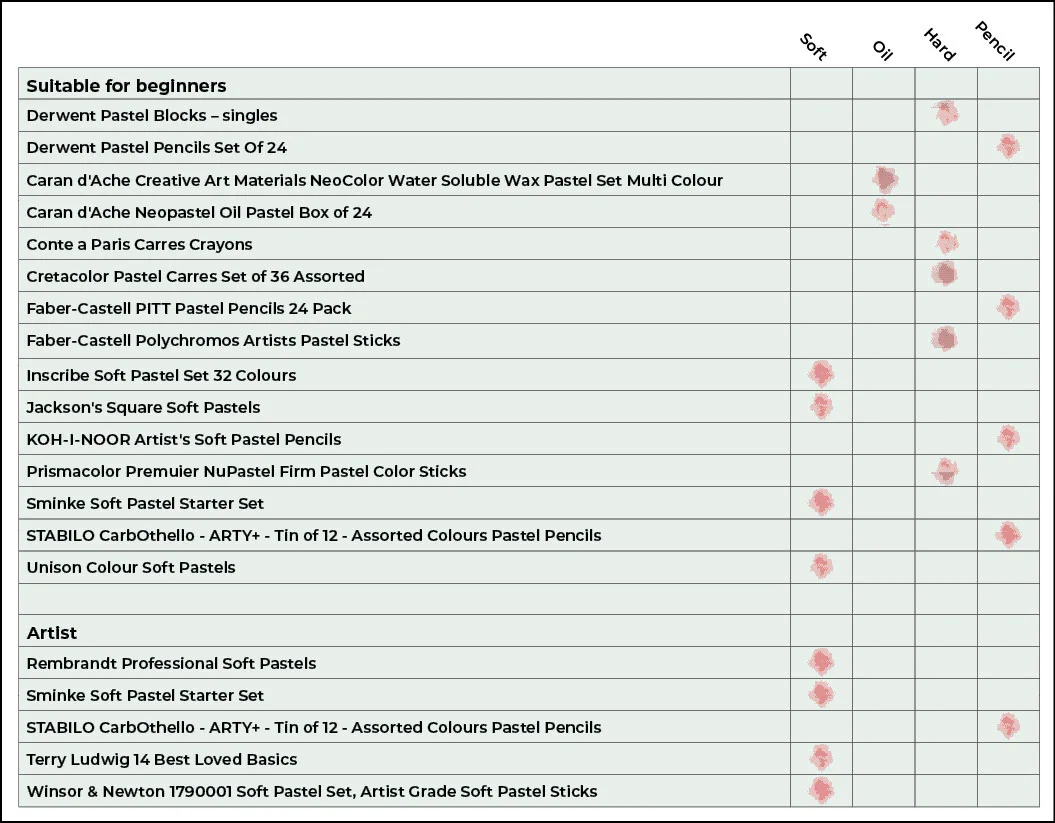
Soft pastels are the most commonly used type among pastel artists. They are composed of a higher proportion and concentration of powdered pigment, a small amount of binder, and very little chalk, giving them their signature soft, crumbly texture and vibrant colours. The pigments used are the same as in oil paints and watercolours, the difference is the binder. Pigments without a binder would not stick to the paper. They are presented in square or cylindrical shapes having been created by hand or machine and allowed to dry.
Soft pastels are easily blendable and can be layered to create rich effects and smooth colour transitions. They can be used on various textured surfaces like sanded paper or pastel boards, however they are prone to smudging and require a fixative to set. They also create dust when used.
Best For: Broad strokes, blending, and creating textured backgrounds.

What are hard pastels?
Hard pastels are firmer, so less crumbly, and contain more binder and less pigment than soft pastels, giving them a more pencil-like structure and making them less vivid in colour. Hard pastels can create fine details and crisp edges. They are often used for under-drawing or initial sketches before applying soft pastels.
Best For: Initial sketches, detailed work, and layering over soft pastels.
What are pastel pencils?
Pastel pencils are essentially hard pastels encased in a pencil form, making them easy to handle and control. They come in a wide range of colours but are less blendable than softer pastels. They can be sharpened for fine details allowing artists to create intricate textures and lines. Pastel pencils can be combined with soft pastels and so are versatile for layering and impasto (the process or technique of laying on paint or pigment thickly so that it stands out from a surface) effects.
Best for: Adding details, fine lines and precision work.

What are oil pastels?
Oil pastels are made from pigment mixed with a non-drying oil and wax binder, creating a creamy, crayon-like consistency and give a very different look to soft pastels. They are almost a hybrid between a soft pastel and oil paints. Oil pastels create rich, intense colours that don’t require a fixative and create no dust making them cleaner to use. They can be used on a variety of surfaces, and are great for those looking to layer and create bold thick strokes and less precise for more detailed work.
Best for: Bold strokes, mixed media art, and layering.
What are pan pastels?
A modern innovation, pan pastels come in a pan format similar to make-up compacts and are applied with sponges or other tools. Pan pastels are highly blendable meaning meaning you can cover large areas quickly and easily with minimal dust. They offer more control over blending and application but are not as easy for creating detailed lines without additional tools.
You can cover large areas quickly and easily with minimal dust. They offer more control over
blending and application but are not as easy for creating detailed lines without additional tools.
Best for: Backgrounds, large areas, and blending.
If you're new to pastels, don't stop here! Explore our other beginner-friendly guides to learn all you need to progress and develop your pastel skills.
Each type of pastel offers unique opportunities for creativity. By exploring the various types, you can discover which best suits your style and artistic vision. Whether you prefer the dusty richness of soft pastels, the detail-oriented nature of pastel pencils, or the buttery texture of oil pastels, there’s a perfect pastel out there for every artist.
Essential tips for beginners...
- Experiment with different types: Try a sample pack or a small set of each type to get a feel for what works best for you.
- Pay attention to your paper: The texture of the paper (tooth) greatly affects how the pastels adhere and blend.
- Use fixatives sparingly: Fixatives can alter the vibrancy of pastels. Use them lightly and test on practise pieces first.
- Practice blending techniques: Practice using your fingers, blending stumps, or special pastel tools to achieve desired effects
If you’re new to pastel art, don’t stop here! Explore our other beginner-friendly guides to learn about choosing the right pastels, blending techniques, framing your artwork, and keeping your creations safe. Each article is packed with tips to help you improve your skills and enjoy your pastel journey
- Beginner’s guide to pigment and binder ratios in pastels
- Beginner’s guide to pastel paper: Types, textures and how to choose the right on
- Beginner’s guide to mastering key techniques in pastel art: Tips for stunning results
-
Beginner’s guide to blending pastels: Easy techniques for smooth and vibrant artwork
-
Beginner’s guide to correcting mistakes in pastel art: Tips and techniques
- Beginner’s guide to organizing your pastels: Tips for easy storage and access
- Pastel safety for beginners: Essential tips for safe and healthy art practices
- Beginner’s guide to using fixatives with pastels: Protect and preserve your artwork
- Pastel art and mindfulness for beginners: Relax, create, and reduce stress
- Beginner’s guide to framing pastel artwork: Tips to protect and display your pastel art

Comments
Login or register to add a comment
No comments