


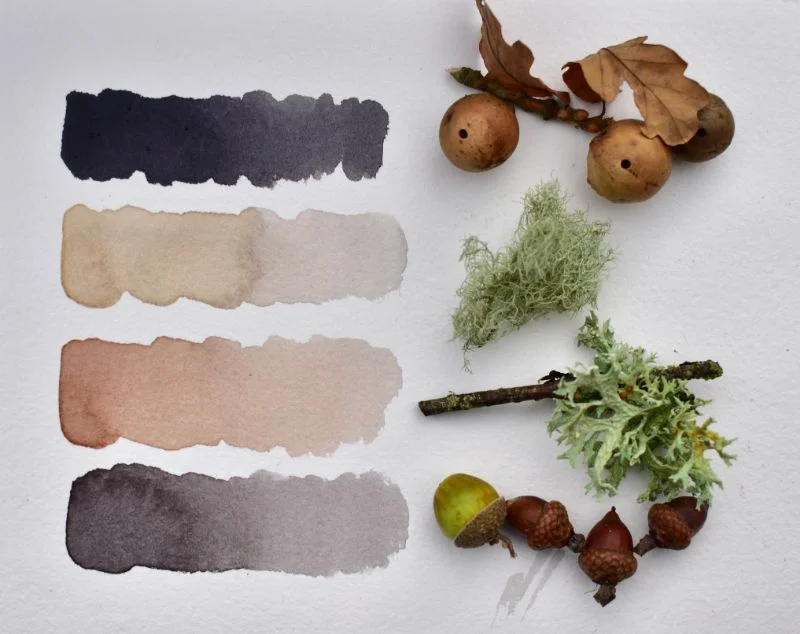
An example of the colours produced and the materials used. The top one is the oak gall ink that was bought online, the remaining three were made by Fiona.
Learn how to make your own historical inks with this guide by Alan Bickley and Fiona Phipps.
Drawing with pen and ink is one of my favourite mediums, and I hoped to make my own inks in the traditional way. I spoke to Fiona about the subject, and she was also interested in creating her own inks.
The process is not instant. It takes time and a degree of patience. I truly believe that the results Fiona achieved were well worth the effort involved! I’ve been putting them to the test, and you can see examples of both Fiona’s and my work below.
The influence of Rembrandt

Alan Bickley, After Rembrandt, Man Sitting in a Chair, A4 Two Rivers paper
I’ve recently been studying the line and wash drawings of Rembrandt, so I’ve based my sketches around his style. His drawings were made using a variety of inks that were available during the 17th century. Two of the most common at that time being bistre (made from wood soot), and oak gall ink, also referred to as iron gall ink.

I had intended to make the oak gall ink. Unfortunately it was too late in the oak tree cycle, so there weren’t any available for me to collect. I was still keen to try it, so I managed to source a small bottle online.
But there were many more options readily available, namely acorn ink, oak leaf lichen ink, and old man’s beard lichen ink. The last three are those that Fiona concentrated on. The raw materials were readily available to her. All that was required was some foraging and a good deal of patience!
The history of ink
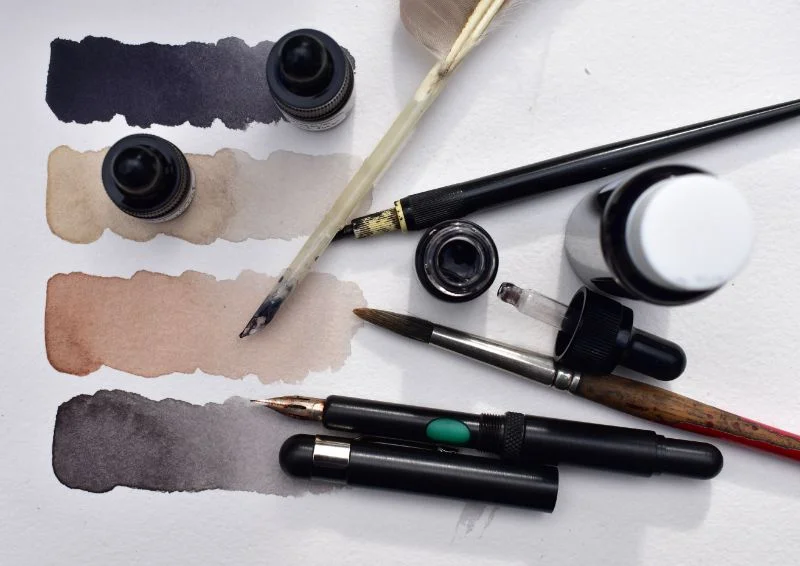
The first ever use of ink by man would have been cave paintings. The Chinese made and used inks in the 23rd century BC for writing, these inks were organic based, from plants and animals. In the 4th century, Indian ink was made from burnt bones, tar and pitch.
The Romans modernised the ingredients and methods of making ink. Ferrous sulphate inks came to the fore. By mixing ferrous sulphate with the tannin obtained from oak galls, it produced a black, long lasting ink for documents. Using sulphate based inks had its drawbacks, as it faded, it corroded the parchment over time.
Inks will always be in fashion and have a strong following, particularly for the modern artist. They are adaptable and in their basic simplicity. They can be used to draw and write with. Calligraphy and script lettering in particular.
How to make Acorn Ink
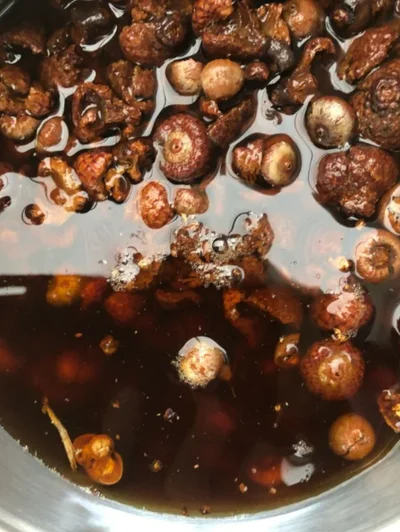
Acorn ink in its first stage of manufacture. Just look at that gorgeous colour already!
I find it incredibly satisfying foraging for the raw ingredients to produce sustainable art materials. In this case, collecting fallen acorns and transforming them into inks that have been made the same way for centuries.
Each new batch will be unique with slight variations in colour, which all goes towards making your artwork original.
Ingredients & method
For my first batch of acorn ink, I used a small amount of the acorns that I’d collected. Roughly about two average size cups, which made around 300ml of finished ink.
Step one
Begin by rinsing the acorns to remove dirt and leaves. Then fold them in a towel and break them up with a mallet or something similar.
Step two
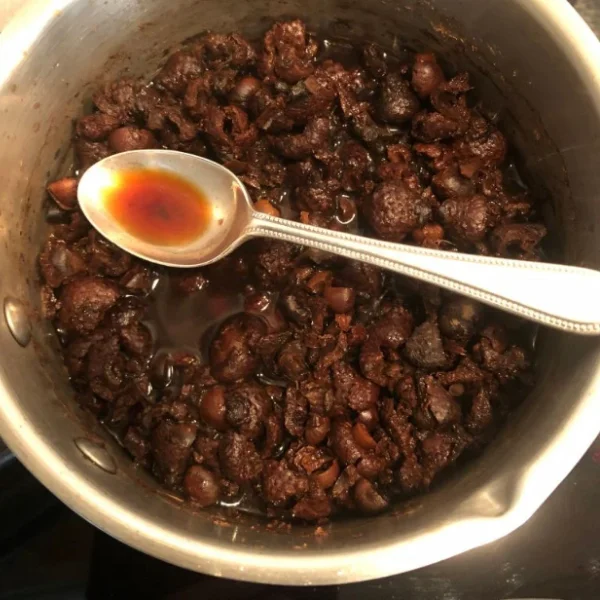
After the acorns have been crushed and boiled
Add the acorn pieces, including the fine bits and dust, into an old pan. Cover with water (preferably rain water), bring to the boil. Simmer for around four to five hours, topping up to just cover the acorns as the water evaporates. The liquid will soon start to darken.
Step three
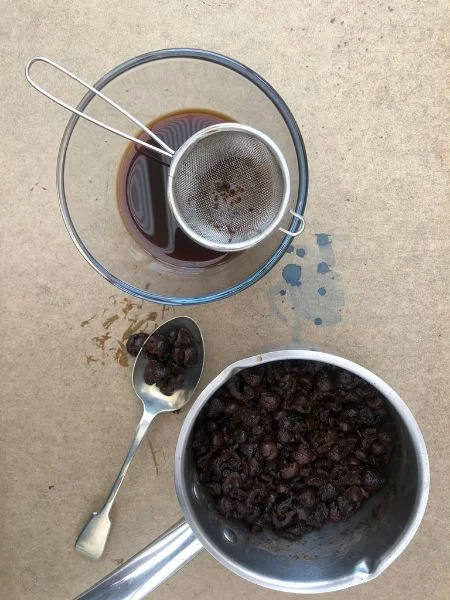
Straining the liquid into a glass jar
When the liquid is the colour you require, or after the five hours, allow to cool. Then strain the liquid off into a glass jar.
Make your own watercolour mediums using foraged tree gums with this handy guide.
Step four
This is where the alchemy comes in, to turn your lovely rich brown liquid into a black/grey ink!
Adding an iron vinegar solution to your brown acorn liquid will instantly change the colour. To make the Iron vinegar solution, add some rusty iron pieces in a jar. Even pieces of steel wool will work.
Half fill the jar with white vinegar and put the lid on. This mix will soon change colour but leave for at least a week before straining it through a sieve and adding to your acorn ink.

Alan Bickley, After Rembrandt, Man Sharpening a Quill by Candlelight, A4 Two Rivers paper
Step five
To take the ink to its final stage, add (up to) one tablespoon of the Iron vinegar solution to your cup of acorn liquid. You can do this in stages depending on how black you want the finished ink. I wanted a dark grey to black rather than an Indian ink colour. I added a little at a time and tested regularly by dipping in a small piece of paper until I had the desired colour.
To bind your finished mix add gum Arabic, a few drops at a time, until you reach a consistency that suits your needs. You don’t need to add a binder but you will find that the ink will sit on the paper rather than adhering to the paper. It also fixes the colour and makes it permanent.
Store in small bottles which have a pipette included in the lid for easy use. I added a couple of cloves in the bottle to act as a preservative, they also tone down the smell of vinegar!
Making oak leaf lichen ink and old man’s beard lichen ink

A variety of lichen that I collected, the Old Man’s Beard is the third one from the left
Ingredients & method
Both the above inks are made in the same manner. You will require separate jars for each ink. There are no set quantity measurements to make this ink, it depends on the volume of how much of the fallen lichen you collect. I gathered a good large handful of each for my first batch and used the small jam jars to make it in.

Starting the process of making the lichen ink
Step one
Break the lichen into small pieces and place in the jar. Making this ink requires a reaction that produces ‘orcein’ and requires oxygen. You need to leave space between the mix and the lid, I left a third.
Step two
Add enough ammonia to cover the lichen (I used household ammonia). Ammonia should always be used in a well ventilated area. The smell and fumes can be overpowering!
Step three
Leave the lichen to soak without a lid, in a well ventilated place, (I used the greenhouse) for about three days to a week.
Stir the mix well every day to aerate. You will notice a change in the colour after about three days, if not before. The Oak Leaf Lichen will start to turn a pale pink to reddish colour. The Old Man’s Beard Lichen will turn a sepia colour.

Fiona Phipps, Ruined Wall, 8x6in, Stillman & Birn sketchbook
Step four
Once the mixture has been left and aerated, dilute with rain water. I worked on a two parts water to one part ammonia. I left a quarter of the jar with the original ammonia and lichen, then added rain water to the three quarter level. The final quarter of the jar I left for oxygen space.

Fiona Phipps, Mill on the Nethan, 12x12in on Saunders 300lb NOT watercolour paper
Step five
This stage is adaptable, it depends on the strength of colour you want your finished ink to be. You can leave this mix for anything from one month to three months, I chose to leave it for one month. Shake the jar daily and vent the top to keep the oxygen levels high.
When you have the required colour, strain, add gum Arabic to your desired consistency. Then bottle your ink, (don’t forget to add a clove) and label.

Comments
Login or register to add a comment