




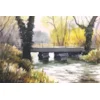

Denise Cat puts a new range of watercolour brushes from top watercolourist, Stephen Coates, to the test.
First impressions
On first impression the brushes, made by ProArte for Stephen Coates, looked a little different from your regular round watercolour brush.
I liked the look of the sleek Rosewood handles. The Spearhead was elongated and finished with a fine point.
Made from synthetic nylon, yet on touch, having the feel of a sable brush.
Top Features:
- Elongated profile
- Ample water retention and controlled release
- Stylish design
- Precision tip
- Soft fibres
- Available in sizes 6, 8 and 10
Where to buy
The full range of Stephen Coates brushes, which start from just £6.60 for a No. 6 Spearhead Round, can be purchased from Art Supplies with Painters Online by
Putting brushes through their paces

Firstly, I did a quick test to identify how much water each brush would hold and how its application would transfer onto the watercolour paper, see image above.
I was impressed with each brush including the mini-hake. The mini-hake and No. 10 especially, held ample water and application of paint went down smooth and evenly.
The fibres expanded really well as some of the hair is wavy allowing more air space, therefore increasing the amount of water the brush can hold.
Getting stuck in

Leeds to Liverpool Canal
I painted a couple of warm-up paintings, such as the one above, before I settled down to a couple of more detailed pieces.
I used all of the brushes, to get a feel for them, on these warm-up paintings.
Using the Mini-hake

Scraggly Head
This portrait above was painted mainly with the mini-hake.
I was incredibly surprised to see just how much detail I could get from this brush.
It holds plenty of water, as you would expect from a hake, and the control and release of water was exceptional - especially when working quickly.
The sharp edges to the hake also made it easy to add some detail, something you wouldn't expect from such a brush.
Using the brushes in more detail
Demonstration: Overhanging Roses

Overhanging Roses
For this painting of the beautiful flowers overhanging from my neighbour's garden, I used a wet-in-wet technique.
Stage one

I don’t use masking fluid so I went straight in with the mini-hake to wet the paper and get the first wash down.
I didn’t have any problems with going around the flowers using the sharp edge of the hake, applying the water and keeping the paper white.
Stage two

I then applied pigment again, using the hake at this stage.
Changing to the Spearhead brushes, starting with a No. 10 I began adding more colour and shape and started to bring some leaves to life.
I then left this to dry.
Stage three
Finally, using the No. 8 and 6 brushes, I worked on putting in more detail and refining the painting.
I wet specific areas of the painting and brought everything forward to completition.
Demonstration: My Alice

My Alice
My final piece was of an historical fishing vessel, called My Alice.
I used a combination of wet-in-wet and some dry-brush techniques, working with the three Spearhead brushes and the mini-hake.
Stage one

Wetting all the background, apart from the boat, shadow and also about an inch below the horizon line, I applied cobalt blue and cadmium red Light.
Once dry, I used the mini-hake to dry brush across the area an inch below the horizon line. This kept areas of the paper white, giving subtle shades of blue as the brush glided across the paper.
I found the brushes really helpful as their elongated tapered shape moved around delicate areas with ease. None of the paint strayed into the white areas.
I left this to dry.
Stage two

Wetting the paper again, an inch below the horizon, I continued to work on the sea and started introducing some shadows from the boat.
Stage three
Now onto the vessel. I mainly used the No. 6 and 8 brushes for the finishing touches.
I found these brushes great for producing some fine details, very impressive!
My findings:
- Exceptional quality, synthetic with the feel and movement of natural hair
- Brushes hold large amounts of water if you are considering large areas
- Their Spearhead shape, tapering into a fine point, make them a step ahead for detailed work
- The mini-hake is versatile and also precise
- The brushes disperse water in an even and controlled movement
- They are beautifully shaped and return to shape
- Designed to look and feel good, they also deliver
Conclusion
The Stephen Coates Spearhead watercolour brushes have a traditional round shape with a difference, being slightly longer with a precision tip.
I really enjoyed using the Stephen Coates brushes and would say they are a must for anyone who works in watercolour.
Suitable for beginners and experienced artists, you have really good control with these brushes.
The quality, look and performance of these bushes is excellent. I will defintely continue to use them!
About Denise Cat
Denise is a self-taught artist who has been painting, drawing and sketching since 2020 having retired early, due to pain conditions, from her job as a cardiology nurse in her home city of Liverpool. She works in watercolour, oil, charcoal, pastel, acrylic and graphite.
SEE MORE FROM DENISE IN THE GALLERY