




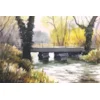

Mary Herbert tries out Caran d’Ache Museum Aquarelle Pencils and finds that they are a ‘serious medium, made for serious artists’
Top features
- Introduced as part of the Caran d’Ache Artists’ range for professional users, these gems have been developed with pigments of exceptional light-fastness, whether used wet or dry.
- The leads are strong enough to be sharpened to a very fine point without breaking, yet soft enough to be sensitive to the slightest pressure on paper and they glide across the surface in a very pleasing way.
- Used with water the colours can be startlingly intense, which took a little getting used to. I found I was applying too much pencil; just a small amount allows a more subtle watercolour wash effect. Reserve heavier applications for an inky look.
- The pigments are clean, consistent, and vibrant.
- They cover the paper easily and feel sensitive to the pressure of my hand, even on a textured surface.

Westie Portrait, Caran d’Ache Museum Aquarelle on mountboard, (20.5x18cm)
Where to buy
Museum Aquarelle drawing techniques
Wanting to see how they work as pure watercolour on a brush, I made a ‘palette’ by scribbling a heavily applied square of each colour on to a piece of rough plastic, and touching them with a wet brush. It was just like using a set of watercolour pans.
A little colour went a long way, and without the fragments I’d been expecting; the pigments dissolved completely into the water. It occurred to me this would be a handy way to take colours travelling or hiking with minimum weight.
Putting plain water into the well of a watercolour palette, I shaved off some lead and let it dissolve. The result was a wonderful rich, inky paint.
Adding other colours meant I could easily mix up a whole batch of a specific hue, ready to cover large areas without stopping to try to match the mix again and again. In effect, you could use a pencil to quickly and economically cover a huge sheet of paper.
Once it was dry, I noticed the colour was permanent and didn’t break into subsequent wash layers in the same way that traditional watercolour would. This allowed for some wonderful glazing effects, deepening the colour and tone of the artwork.
Whilst wet, it behaved just like conventional watercolour and I could lift out, and drop colours in the usual way, as well as applying salt effects and so forth.
Creating different effects with Museum Aquarelle
These pencils really impressed me when I combined their wet and dry properties.
Spraying, brushing, or dropping water on to Museum Aquarelle pencil marks resulted in a host of effects, depending on the water-to-pigment ratio and the relationship between colours on the paper.
A line drawing could be lightly washed over, leaving the original drawing softened and tinted, which I thought was a lovely effect. If the pencil was first dipped in water, it made more opaque marks on the paper that released less pigment when washed over after drying.
For a pretty marbled finish, I scattered tiny shavings from the leads of different colours on to the paper and then brushed over with plenty of water, letting the colours mingle.
To enhance this effect, once it was dry I scribbled over the wash with the white pencil and then smeared it with a damp finger, resulting in an irregular misty scumbling.
Shaving the colours on to a fresh wash or plain wet paper was quite an exciting experience as I watched them seem to melt. I used a sharp blade for this, running it at a 45° angle along the lead produced a fine dust, whereas a 90° angle gave me a thin flake.
The bits adhered to the paper in colourful speckles and dried to leave a pleasingly textural finish. Dropping more water on to them or brushing it over them spread the colour out.
Pencils for professionals
Caran d’Ache have aimed this product at the professional user, and the reasoning behind that isn’t mere marketing hype.
Museum Aquarelle pencils have been made with the best selection of pigments, including a large number of mono-pigments (pure, unblended colour from source) and highest quality translucent mineral filler.
Pigment makes up an average of 30 per cent of the lead weight. Caran d’Ache told me that one single Museum Aquarelle pencil contains more pigment than a half pan watercolour cake.
I tested the pigment strength by increasingly diluting a small square of pencil drawn on Bristol board.
Working down the long side, I reached the other end of an A4 sheet with colour still drawing out, far exceeding my expectations.
The lightfast properties, too, are beyond impressive. Of the 76 colours in the range, 61 have a maximum score of five stars on the Blue Wool Scale, assuring at least 100 years of stability in normal room conditions, whether applied wet or dry.
Providing the link between drawing and watercolour, Caran d’Ache have excelled themselves in bringing artists a wonderfully robust and versatile medium.
Working with Musem Aquarelle

Frank and Pete, Caran d’Ache Museum Aquarelle on Bristol board, (23x25.5cm)
- I prepared the painting above with generous washes of water over coloured lead shavings.
- Whilst still wet, I shaved colours on to the bottom right corner to give the effect of flowers and grasses.
- The dark trees in the background were sprinkled with salt and then finger-scumbled with white and pale lilac pencils.
- To introduce texture to the muddy ploughed strip, I scribbled directly on to the paper and then added water with a wet brush.
- I did the same with the stalky grass, drawn in short lines.
- The white splodges on the ground were made with a wet-tipped pencil.
- For Frank the Suffolk punch and his handler Pete I made a palette as described, and applied a couple of layers of colour with a brush.
- I finished with sharp pencils, drawing directly on to the figures to tighten details.
ORDER YOUR MUSEUM AQUARELLE HERE
Sometimes we may include links to online retailers, from which we might receive a commission if you make a purchase. Affiliate links do not influence editorial coverage and will only be used when covering relevant products.