



Discover the basic principles of watercolour paint and the different types of paint available.
Understanding the properties of watercolour paint
Types of watercolour paints
Watercolour painting is a beautiful medium known for its soft washes, delicate transparency, and dream-like textures. But it helps to know what types of watercolour paints are out there - and which might suit your needs as a beginner. From compact pans to luxurious tubes, watercolour paint comes in various forms. Each type has its own feel, flexibility, and price point.
Here’s your essential guide to get you painting with watercolour paints, with confidence.
Watercolour pans

Faber-Castell watercolour pans
Watercolour pans are small, solid blocks of dried paint set into plastic trays. To use them, you activate the pigment with a wet brush. They come in two common formats: Half pans – small, compact, and great for travel sets and full pans – larger and easier for bigger brushes. Watercolour pans are ideal for beginners who want flexibility and simplicity and artists who paint outdoors or while travelling
- Best for beginners, travel sketching and convenience
- Quick and easy to use
- Easy to transport and store
- Long-lasting; a little goes a long way
- May require a bit more effort to build up strong colour
- Some colours can dry with a chalky finish if low quality
Watercolour tubes
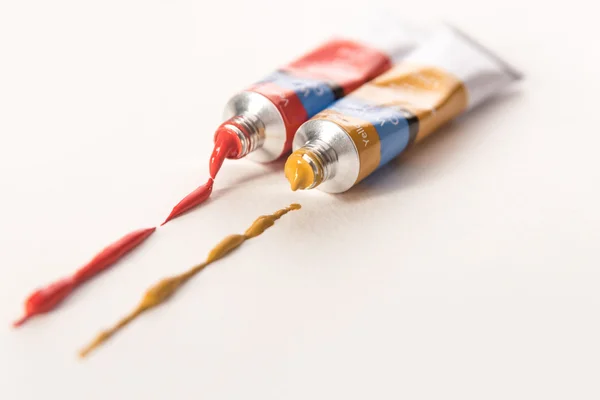
Watercolour tubes contain concentrated, creamy paint in a moist paste form. You squeeze out the amount you need and dilute it with water on your palette. They offer intense pigmentation and are excellent for mixing custom shades.
Watercolour tubes are great for beginners who want brighter colours. They are also perfect for artists working at a desk or in a studio.
- Best for studio painting, strong colour payoff and mixing
- Rich, vibrant colour straight from the tube
- Easier to mix large washes
- Ideal for covering bigger areas or detailed layering
- Requires more setup (palette, water, clean-up)
- Tubes can dry out if left open
Watercolour pencils
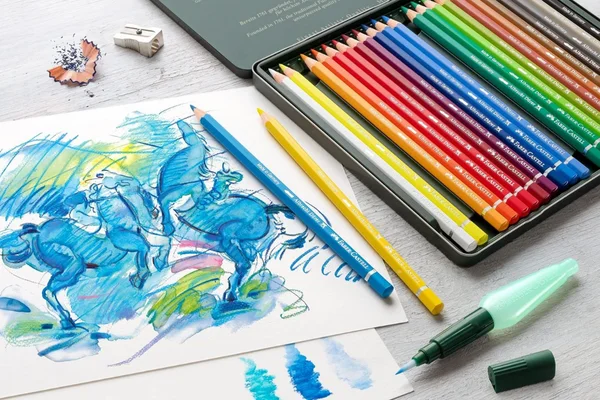
Faber-Castell watercolour pencils
Watercolour pencils look and feel like coloured pencils - but with a twist. Once you draw with them, you can use a wet brush to activate the pigment and transform your lines into paint. They’re great for beginners who enjoy drawing or want control before committing to paint.
Watercolour pencils are ideal for beginners who feel more confident with dry media. They are also useful for artists who like sketching and gradual colour building.
- Best for sketching, precision and mixed media
- Easy to control and no mess
- Great for fine detail work
- Combines well with ink and other media
- Blending takes practice
- Colours are usually softer than traditional paint
Liquid watercolour (inks)

Ecoline Liquid Watercolour
Liquid watercolours are pre-mixed pigments with smooth intense colour. Artists often use them for illustration, lettering, and modern watercolour styles where brightness and boldness matter. Liquid watercolour is ideal for artists exploring bold techniques and for use in mixed media work.
- Best for vibrant illustrations, calligraphy and modern styles
- Super vibrant and fluid
- Great for wet-on-wet techniques and drips
- Convenient - no activation needed
- Many are dye-based and not lightfast (can fade)
- Can stain brushes and palettes
If you're new to watercolour, don't stop here! Explore our other beginner-friendly guides to learn all you need to progress and develop your watercolour skills.
Which type of paint is right for you?
Pans: Best for on-the-go painting and beginners
Tubes: Studio use, bold colours and custom mixing
Pencils: Drawing lovers, precision and mixed media
Liquids/inks: Bold illustration, calligraphy and mixed media
Understanding the properties of watercolour paint
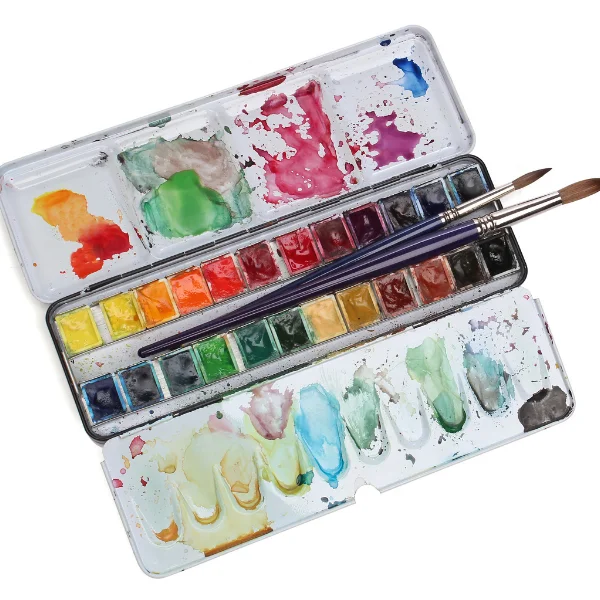
Watercolour paints may look delicate, but they’re full of personality, with unique properties. Here’s what you need to know:
What is watercolour paint made of?
At its core, watercolour paint is a simple blend of three ingredients.
Pigment is the coloured substance that gives the paint its hue. Pigments can be natural (from minerals, plants, or earth) or synthetic.
The binder is usually gum arabic and is the sticky substance that holds the pigment together. This is what allows it to stick to the paper when dry.
The additives improve the fluidity and help to keep the paints moist. In some paints the additives can be honey, glycerin, or preservatives, whch can also help to extend their shelf life.
Fun fact: The reason watercolour feels so different from other paints is because it contains less binder. This makes it more fluid, transparent, and reactive to water than oils or acrylics.
Staining versus lifting

Some pigments stain the paper, making them hard to remove once dry. You can lift or lighten others with water or a damp brush. Staining colours are great for bold, vibrant layers. Non-staining colours are more flexible and better for adjusting or softening.
Beginners tip: Look for labels on your paint tubes or swatch cards. Manufacturers often rate colours as staining, semi-staining, or non-staining.
Transparency versus opacity
One of the most beloved features of watercolour is its transparency. It allows light to shine through layers of colour, giving paintings that luminous, glowing quality. Transparent colours let the paper and previous layers show through. Opaque colours are denser and can cover previous layers more fully.
Beginner’s tip: Transparent paints are ideal for layering (also known as glazing). Opaque colours work well for final touches or corrections.

Granulation
Ever notice that some paints dry with a slightly speckled or textured look - this is granulation. The pigment particles do not distribute evenly. Granulating colours add a lovely, organic texture to skies, rocks, or natural scenes. Smooth colours dry with even, flat washes.
Beginners tip: Experiment on different paper types – granulation often appears more strongly on textured (cold-pressed) paper.
Lightfastness
This refers to how well a colour resists fading over time when exposed to light. This is especially important if you plan to display or sell your work. High lightfastness is long-lasting colour, low lightfastness is more prone to fading.
Beginners tip: Check paint ratings (ASTM scale) and aim for colours marked ‘excellent’ or ‘very good’.
Pigment numbers

Not all colours are made the same – even if they look similar. Many watercolours are made from a single pigment, while others are blends.
Single-pigment paints offer cleaner mixes and are easier to control. Multi-pigment paints can create muddy mixes if overworked. Understanding what’s in your paint helps you mix more confidently and avoid dull results.
Tinting strength
This tells you how strong or weak a colour is when mixed with others. High tinting strength means a little goes a long way (think phthalo blue!). Low tinting strengthgives a more subtle influence in mixes.
Beginners tip: Use sparingly with strong colours to avoid overpowering your mixes.
Each watercolour has a character of its own - some are bold and assertive, others soft and subtle. The key is playing and swatching. Make your own paint chart, test how they mix, and notice how they behave on different papers. Over time, you'll build a palette that reflects your own artistic voice.
Pick three watercolours - a transparent, a granulating, and a staining one - and paint a simple gradient or wash. Observe how each behaves differently. You’ll learn more in five minutes of play than hours of reading!

Comments
Login or register to add a comment
No comments