



Help is at hand with these five common problems and how to overcome them.
I can’t draw real things; I can only copy from photos
My drawings look like a ten-year-old has done them
Drawing perspective on buildings is far too complicated
I can’t get the proportions right
I have to rub out so many wrong lines I end up with a mess
Many people think that drawing is a skill you are born with rather than one you learn. A few artists may have a natural ability, but this is rare. Good drawing underpins a painting; even abstract artists need a thorough grasp of shapes and proportions.
You can improve your drawing skills with a little understanding and a great deal of practice. Here are five common drawing problems and how to overcome them.
Problem 1: I can’t draw real things; I can only copy from photos
Draw through a window
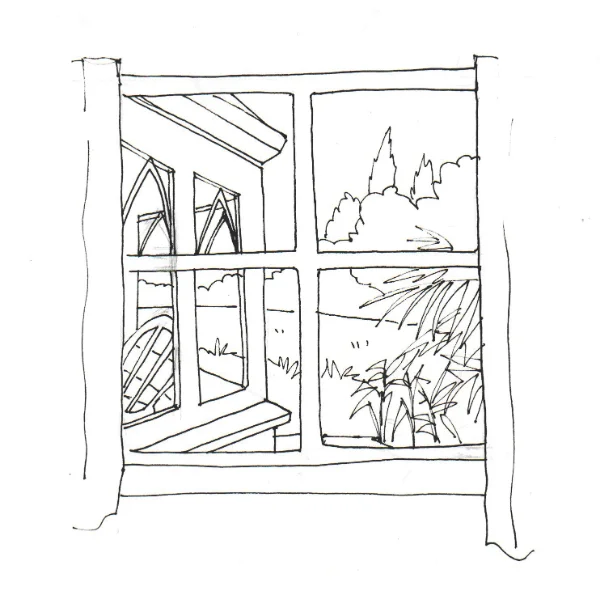
Look at the view through a window frame in the same way as you would work from a photograph
The hardest challenge when you draw from life is turning a three-dimensional scene into two dimensions. Put the photos away and take out the sketchbook. Don’t panic, you can stay indoors and look out of a window, or through a door. Choose a scene with interesting overlapping shapes.
The window helps you turn three dimensions into two as it echoes your page and acts as a viewfinder. Draw a frame on the page the same shape as the window then draw on the page as if you were drawing straight onto the glass; one line at a time. Notice where each line meets the edge of the window and how it relates to another.
The wonder of drawing is that you are the magician. If your lines are in the right place, the eyes looking at the drawing will translate them into three dimensions again. If they’re not in the right place, this magic won’t happen, which is why drawing in perspective is so frustrating.
When you go outdoors to sketch, take a viewfinder with you and use that to help you frame and select your scene. You can buy viewfinders from an art shop, but they’re easy to make using stiff paper.
Prolem 2: My drawings look like a ten-year-old has done them
Draw for at least five minutes every day

Think of learning to draw as you learnt to write. It takes constant repetition and practice to refine your style
You have some catching up to do. As children we draw without inhibition. We then sideline drawing in favour of words, as we get older. We learn to read at the same time as we learn to write so these skills progress together, but drawing is different.
The result is that our ability to ‘read’ a drawing far outstrips our ability to ‘write’ one. The gap is wide and embarrassing, as your critical faculty far outstrips your ability to do it. Keep at it, a little every day, and bring yourself up-to-date. The good news is that your sketchbooks can stay private; nobody but you will see your efforts.
Problem 3: Drawing perspective on buildings is far too complicated
Buy an angle finder
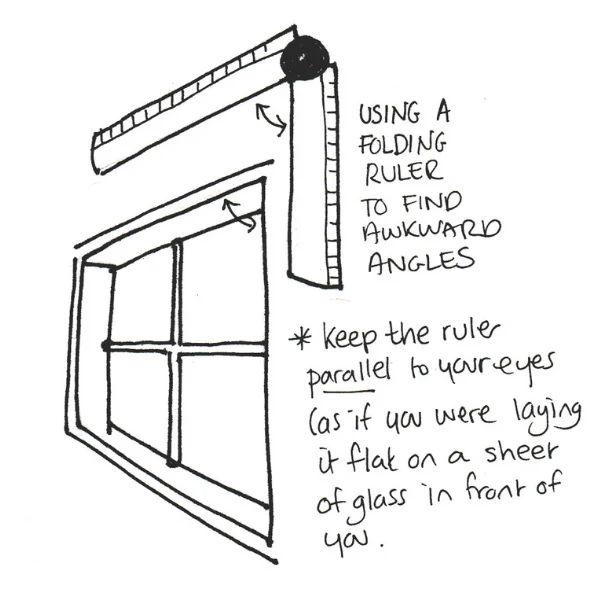
A good high street stationery shop will stock a folding ruler. Here’s one way of using it
When you draw something in perspective, you’ll find that vertical lines stay put; it’s everything else that shifts around. Line up one half of an angle finder with an upright, say the edge of a building. Move the other half until it lines up with the tricky edge (top right) - it can help to shut one eye. Transfer this directly to your page and it will be correct.
What you’re doing is using the evidence of your eyes to shut your interfering brain up. The job of the brain is to interpret odd edges and angles to make sense of your world. "It’s the edge of a house, it’s parallel to the ground," your brain will insist, peering around corners. "Not from where I’m looking," is your eyes’ reply, "and I have the evidence to prove it."
Perspective is, of course, much more than this. Just remember to trust your eyes not your brain and you’ll overcome the trickiest bits. Forget what shape you know an object to be, but ask yourself: what shape is it from where I’m standing?

Problem 4: I can’t get the proportions right
Measure and compare
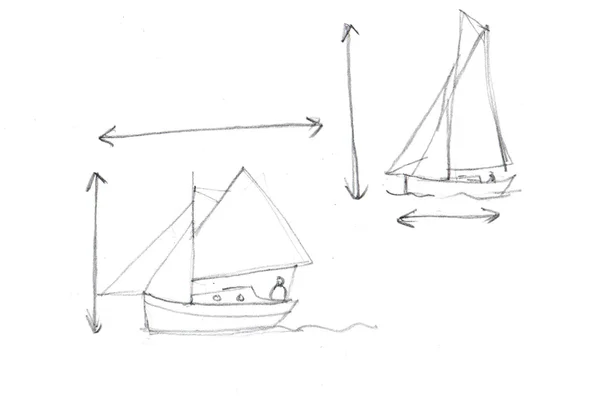
Learn to measure accurately. How high is your object compared to how wide
The most important question you need to ask about any object is: how high is this compared to how wide? If you get this right, everything else will follow, but if it’s wrong, it will only get worse. Don’t leave it to chance; take the trouble to ensure it is correct and, after a while, it will come instinctively.
Why do we find it so difficult? When looking at a scene, we mostly turn our heads side to side, not up and down, so our viewpoint is wider than it is high. Our drawing paper is a rectangle, however, and we try to squish our wide scene into a narrow box. The results are disappointing with dumpy boats and buildings or wide landscapes compressed into a rectangle.
The solution is simple: look at what you want to draw, extend your arm and shut one eye. Choose what seems to be the shortest edge and measure with your thumb how far down your pencil it comes. Now keep your thumb there and turn your pencil to the widest part.
How many times does that short edge fit into the longer edge? If it’s the same size, your drawing will fit into a square. Keep making comparisons all over your drawing. also bear in mind the tendency to draw the things that interest you larger then theys hold be.
If you're new to drawing, don't stop here! Explore our other beginner-friendly guides to learn all you need to progress and develop your drawing skills.
This process of ‘question and compare’ also helps you notice how much smaller further away objects are than nearer ones. Our tricky brains will tell us that two objects are the same size. Your eyes will see that one is half the size of the other because it’s a little further away.
Treating everything as a series of connected shapes and lines will help you to produce a cohesive drawing. Your sketches will be proportionate and related. Give it a go and don’t be embarrassed if people look at you - you’re an artist; it’s what artists do.
Problem 5: I have to rub out so many wrong lines I end up with a mess
Put the eraser away

Draw lightly with a soft pencil. Keep going over the lines until they appear right
You draw a line, it looks wrong, so you rub it out. You draw another line and that’s also wrong so you rub that out, and your page looks such a mess you give up. Does that sound familiar?
Begin drawing with light lines, using a soft (B or 2B) pencil, feeling your way into the drawing. If it helps, put reference points or construction lines in to help you find the shapes. Some people find it useful to draw a series of shapes, such as a square or triangle that they know fits the proportions. If you draw a wrong line, leave it there; you’ll know where not to draw next time.
Keep going until the shape comes into focus then strengthen the lines you want to keep. If the drawing still looks too messy, rub out the wrong bits, using a sharpened eraser. I have a fine-pointed refillable pencil eraser, which is great for detail. You may find that you don’t need to rub out, however, as your eye will focus on the stronger lines and ignore the weak ones.
When you feel a bit more confident, try drawing with a sketching pen. Feel your way in with a light touch, then strengthen the lines that you’re sure of. If you end up with a mess, never mind, it will be a useful mess!

Comments
Login or register to add a comment
No comments